
AI Job Anxiety – The Next Catalyst for Edtech
Early Google data suggests the AI economy may send workers back into classroom

TL;DR
AI job anxiety may trigger a new education enrollment cycle. As workers become uncertain about the future of their careers, many may seek credentials to reskill or improve job security.
This pattern has historical precedent. During the early stages of the Great Recession, labor market uncertainty drove millions of working adults back into degree programs, certifications, and vocational training.
Google search data suggests the shift may already be beginning. Searches related to AI job insecurity are rising alongside searches for education and training programs.
Healthcare and skilled trades searches show the strongest momentum. Programs tied to regulated professions or physical work appear particularly strong.
Thesis: Anxiety About AI Will Drive Credential Growth; Google Search Data Provides Early Support
At first glance, my thesis may sound obvious.
We’re all scared about what AI might mean for our jobs. Of course workers are going to go back to school to retrain and get advanced degrees.
The public markets aren’t so convinced.
Most Education Companies aren’t currently trading at premium valuations. Some stocks in the sector remain deeply out of favor (disclaimer, I own the out of favor stocks). The public markets are pricing some edtech assets as structural AI-losers, like credential providers Coursera and Udemy.
Publicly traded for-profit universities are growing 2026 revenue at less than 10% YoY on average, a level that typically falls short of what investors expect from a growth sector.
Twenty years ago the situation looked quite different.
When I was a sell-side analyst covering the edtech sector in the mid-2000s, postsecondary companies experienced both rapid enrollment growth and significant valuation multiple expansion.
During the early stages of the Great Recession, labor market uncertainty drove millions of working adults back to school. As layoffs mounted and career paths became less certain, enrollments surged across degree programs, professional certifications, and vocational training.
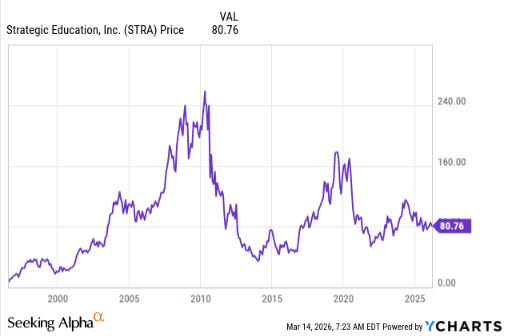
Strategic Education, one of the few remaining publicly traded companies from that era, was one of the great investments of the 2000s. As you can see from the chart below, even today the stock has never fully recovered its historical peak. I own the stock.
Granted, a lot has changed since those days.
Traditional universities saw the success of for-profit institutions serving working adults online and moved to replicate the model, often partnering with services companies to do so. It’s a much more competitive market. That being said, the remaining for-profits have innovated, created a more workforce appropriate curriculum, and focused on supply scarce sectors like healthcare and vocational training.
Will AI-driven disruption trigger a similar wave of enrollment growth that we saw during the Great Recession? Will labor uncertainty drive enrollment in singular short online courses?
Looking for Early Signals in Google Data
Understanding consumer behavior is exactly what Google Trends was designed to capture.
Investors often dismiss Google Trends data. Ironically, if the dataset were sold for thousands of dollars per year, it might receive far more attention. Because it is free, it’s often overlooked.
Search behavior has repeatedly provided early signals about shifts in consumer sentiment. When people become anxious about something — housing prices, layoffs, recessions, or career prospects — their concerns often appear first in search queries.
AI may now be producing a similar signal on credentials.
Search data suggests that anxiety about AI and job security is rising. That anxiety may be translating into increased interest in education and retraining programs.
Limitations do exist in interpreting this data.
It’s unclear whether the increase in AI-related job anxiety searches is coming from working adults already in the labor force or from recent graduates entering it.
Entry-level hiring in several sectors has weakened. AI tools are capable of performing tasks traditionally assigned to junior employees.
We know that law and MBA graduate school applications have been increasing for the past two years.
Even if the Google data reflects more junior professionals seeking to go back to school, the broader implication may be similar.
When individuals become uncertain about their career prospects, they pursue additional credentials, retraining programs, or alternative career paths. Free AI generated content will not replace the value of credentials. Investors I speak with disagree on this.
Thus the benefit of looking at Google data.
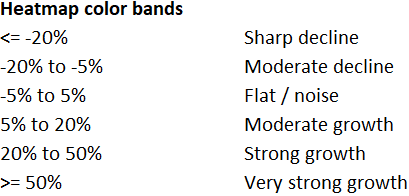
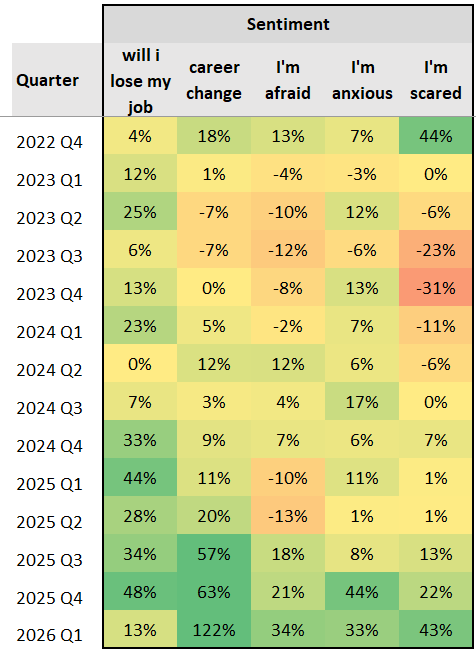
Below are several heatmaps showing the year-over-year change in Google search interest for AI job anxiety and education-related keywords since 2021.
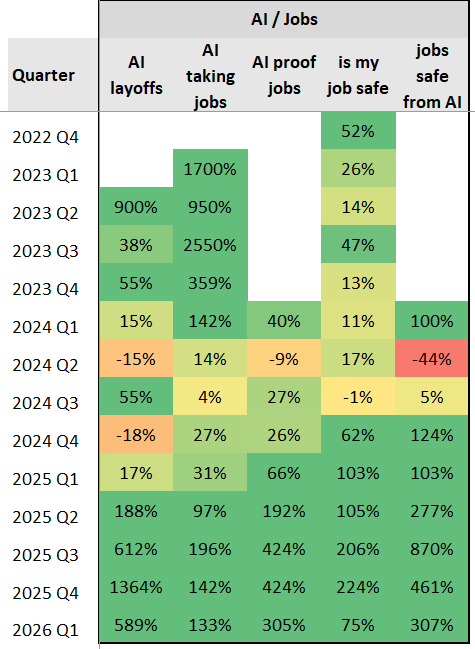
Heatmap 1: AI Job Anxiety Search Momentum
Year-Over-Year Change in Google Search Interest (Quarterly)
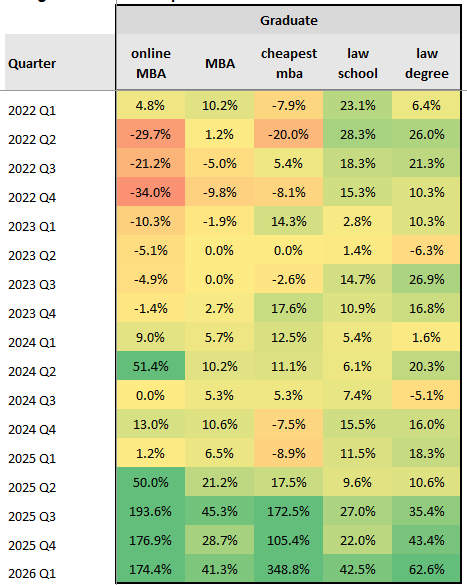
Heatmap 2: Graduate School Search Momentum
Year-Over-Year Change in Google Search Interest (Quarterly)
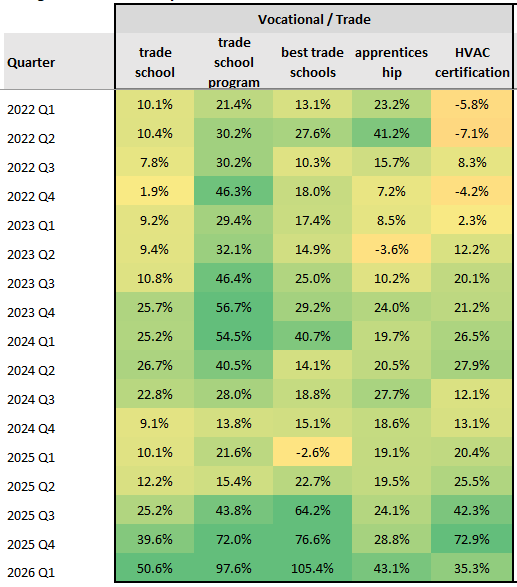
Heatmap 3: Vocational and Skilled Trade Training Searches
Year-Over-Year Change in Google Search Interest (Quarterly)
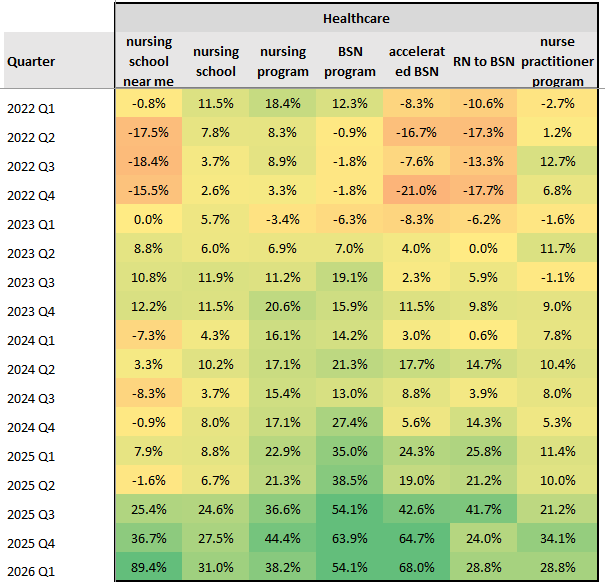
Heatmap 4: Healthcare Education Program Searches
Year-Over-Year Change in Google Search Interest (Quarterly)
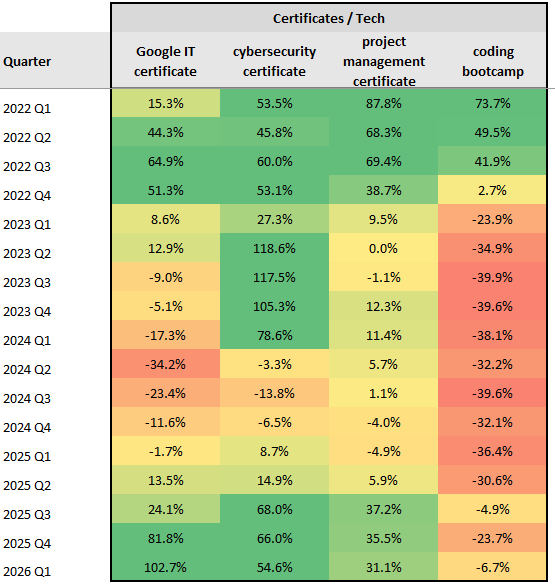
Heatmap 5: Professional Certificate / Short Courses Searches
Year-Over-Year Change in Google Search Interest (Quarterly)
Key Points from the Heatmaps
You’ll notice that at the bottom of each heat map it tends to be a dark color green. That means that YoY Google search words are greater than 50%.
The more analytical way to say this: beginning around Q2–Q3 of 2025, several education-related search terms begin showing very strong year-over-year growth.
Take another look at the heatmaps, you’ll see what I mean.
Regarding AI uncertainty, you’ll see that:
• Searches such as AI layoffs, AI taking jobs, and is my job safe have accelerated over the past several quarters.
• These queries were rare just a few years ago.
• AI-related labor anxiety is beginning to enter mainstream awareness.
Graduate program searches have also shown strong growth over the past three quarters.
It’s difficult to determine who is driving this trend. The searches could be coming from college students, recent graduates struggling to enter the workforce, or mid-career professionals considering additional credentials.
Healthcare-related program searches have also increased meaningfully over the past three quarters.
• Healthcare careers combine strong labor demand and low automation risk.
• Workers seeking stability may increasingly view healthcare as a safe career path.
The same is true for skilled trades and vocational training keywords.
• These occupations involve physical work that is difficult to automate.
• Vocational programs offer shorter training cycles and faster entry into the workforce.
Short technical credentials also see growth over the past three quarters.
Searches for cybersecurity and IT certifications have strengthened.
Interestingly, searches for coding bootcamps continue to trend downward, mirroring real world realities of the end of coding bootcamps.
Video killed the radio star. AI killed the coding bootcamps.
Implications for Edtech Companies
We haven’t really seen this AI fueled anxiety manifest itself in the form of accelerating revenue growth at the publicly traded companies.
But… the Google search volume has only seen strong growth since Q2/Q3, conceivably there may be a lag between rising search interest and actual enrollment decisions.
Here’s what we know: periods of labor market disruption often lead workers to pursue additional credentials, retraining programs, or career changes. Yes, AI changes things. But apparently students are applying to law school in record numbers even with the understanding that the legal profession is a prime target for disruption by AI.
So it will be interesting to see what happens over the next four quarters.
The programs most likely to benefit tend to share several characteristics, they:
• provide career-focused training
• lead to licensed or regulated professions
• offer clear employment outcomes
Many of these programs are concentrated in areas such as:
• healthcare education
• vocational and skilled trades training
• career-oriented degree programs
Education companies with strong exposure to healthcare and vocational programs have shown stronger enrollment growth and higher valuation multiples than peers.
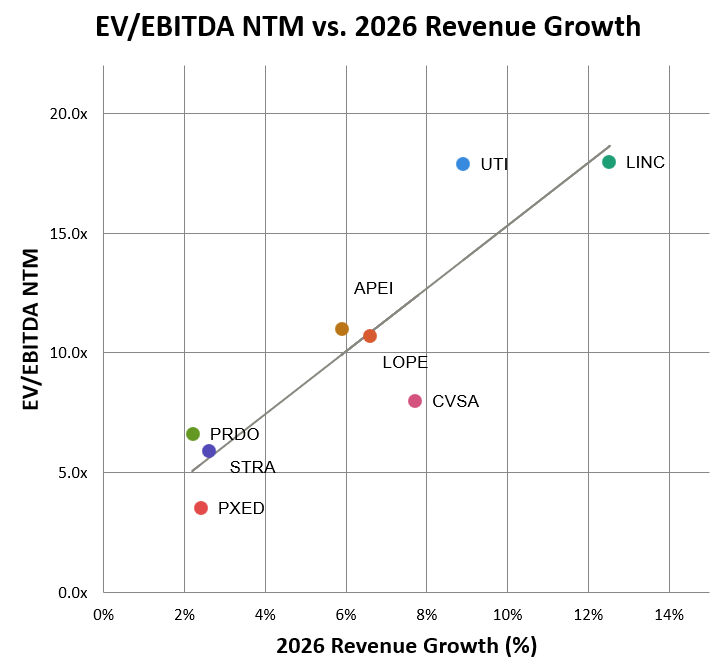
This dynamic is visible in current market valuations. Among publicly traded for-profit education companies, EV/EBITDA multiples show a strong positive correlation with forward revenue growth (R² ≈ 0.72).
The two highest-valued names in the group — Universal Technical Institute (UTI, 17.9x) and Lincoln Educational Services (LINC, 18.0x) — are both pure-play vocational and trades-focused operators. Both serve working adults in career-technical programs with direct employment pipelines, precisely the profile most likely to benefit from accelerating enrollment demand.
By contrast, companies with more diversified or generalist program mixes trade at a significant discount. Strategic Education (STRA, 5.9x) and Perdoceo (PRDO, 6.6x) both carry 2026 growth expectations below 3%, and their multiples reflect it.
Conclusion
Jack Dorsey at Square announced a massive restructure with over 4K employees let go, half of that company’s workforce, to pivot towards an AI centric model
That is not a good sign for the labor market and society overall. Maybe we’ll see double digit unemployment, societal unrest, and all that comes with that,
What may be less appreciated is how workers respond to all of this uncertainty.
The Google search data suggests that individuals are increasingly:
• worrying about job security
• exploring alternative career paths
• searching for education and training programs
One of the earliest economic effects of the AI revolution may be surprisingly traditional:
More people getting credentials.
If AI becomes a source of widespread labor uncertainty, education will evolve from a discretionary purchase into career insurance.
Disclaimer: this is for entertainment purposes only. Do your own research
I own the following education stocks: COUR, UDMY, PXED, STRA, and LOPE.
Appendix: Methodology
To explore potential shifts in education demand, I analyzed Google Trends search data beginning in January 2021.
The analysis followed three steps:
Google Trends data was collected for keywords related to AI job anxiety, degree programs, vocational training, and short-cycle credentials.
Raw search index values were converted into year-over-year percent change, done by ChatGPT.
Data aggregation and visualization were performed using Excel with assistance from AI tools.
I can send the spreadsheet upon request