
AI May Break Coursera And Udemy's Business Model. Why I Still Own the Stocks.
Reposting on Substack

I’ve started to experiment the best way to publish thought pieces. Previously I published this article on LinkedIn. Given that I’m making a commitment to Substack, I’ve decided to repost this article that I previously published on LinkedIn.
I published this on February 24th. Several weeks later, there are already updated to this piece that are required, particularly following the SEC filing of the S4 which explains the documented background of the merger. I will follow up on this platform as to updates regarding Coursera / Udemy.
Introduction
I’m currently a shareholder of both Coursera and Udemy stock.
Since September, Coursera shares have declined roughly 50% and Udemy roughly 30%. Following the announced merger and the projected $115M in cost synergies to be realized within two years of closing in 2H of 2026, I expected multiple expansion. Instead, the stocks declined ~20% since the deal announcement.
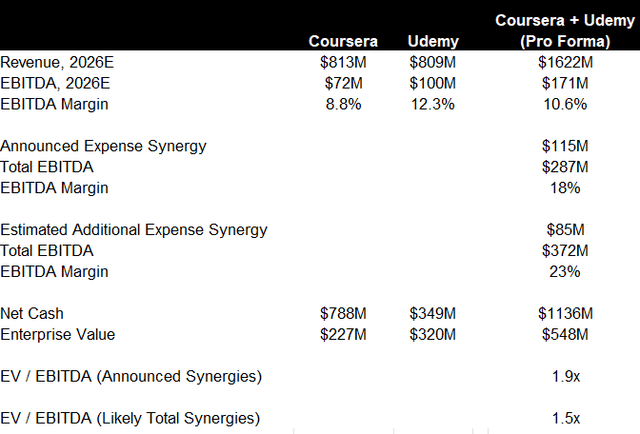
The combined Coursera/Udemy entity, referred to in this article as “New Coursera,” trades at roughly 1.9x pro forma 2026 EV/EBITDA assuming the $115M in synergies. The stock price seemingly reflects existential doubt surrounding the company’s future.
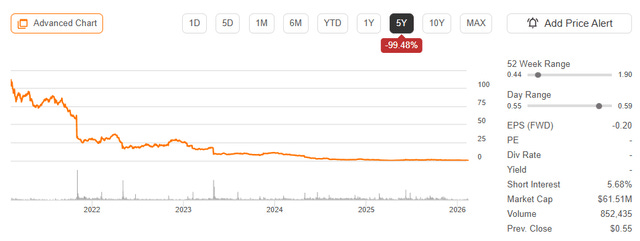
Some context for the non-finance inclined: the overall stock market as of January 2026 traded at roughly 16x EV/EBITDA. Edtech provider Chegg, whose core business provides content to students for “homework help”, saw severe demand substitution following the launch of free large language models (LLMs) which drove revenue down by 50% within two years. Chegg trades at 2x forward EBITDA. Chegg management’s strategy includes harvesting its legacy business for cash. When New Coursera trades near Chegg’s multiple, the market is implicitly suggesting that New Coursera will see similar value destruction.
Over the past two months, several investor friends have argued that LLM generated content will render New Coursera obsolete. Their comments led me to spend my free time understanding threats from LLMs and how agentic AI will transform the Internet marketplace model. There has been a fair amount of academic literature on this subject. AI may affect marketplaces like Expedia, Booking.com, Zillow and others including New Coursera.
To date, no financial evidence exists that AI and LLMs have materially impacted Coursera or Udemy’s financial results. 2025 revenue trends show Udemy’s enterprise business grew 6% YoY and Coursera’s consumer business grew 10% YoY.
In my opinion, the threat for New Coursera is not that generative AI produces free content. Rather, that AI weakens the economics of digital intermediaries.
In this article, I argue that New Coursera’s marketplace model at minimum may face margin pressure over time. Customer acquisition costs may rise. Enterprise pricing may decline given substitution risk. The timeline is uncertain, but the structural pressures are real. The unexpected merger between Coursera and Udemy in my opinion highlights leadership’s proactive strategic foresight in a rapidly transforming landscape. Scale is required to meet the AI challenge.
The stock prices of Coursera and Udemy currently reflect what may go wrong in the future. I think they are discounting what can go right, which is why I remain an investor.
AI will likely lead to an unprecedented labor market dislocation. Federal Reserve Governor Michael Barr recently provided a doomsday scenario where “layoffs soar, leading to widespread unemployment in the short run and declines in labor force participation over time, as a large share of the population is essentially unemployable.”
New Coursera stands at the epicenter of reskilling and upskilling workers for consumers and enterprises. Labor market displacement may serve as a valuable catalyst for sales of New Coursera’s verified credentialed courses.
The merger of complementary businesses, elimination of duplicative costs, consequent share repurchase program, and potential societal tailwinds have me in this stock for at least another year.
I am publishing this analysis not to express an investor view on Coursera and Udemy. Rather, because I thought my industry peers might benefit from my research on how LLMs are reshaping the economics of content, discovery, and digital marketplaces. Much of the public discussion focuses on surface-level disruption narratives. By working through this case study, I have attempted to clarify how LLMs affect marketing efficiency, intermediation, and credential signaling. Even for those with no exposure to these particular equities, the framework should be applicable to evaluating other edtech and marketplace businesses facing similar structural transitions.
Executive Summary
New Coursera is not a content company. It is a credentialing company, which provides protection from LLM substitution. The economic value lies in issuing branded verifiable credentials backed by universities and corporations. LLMS can replicate and distribute raw instructional content. Not credentials. As such, I don’t think that revenue dramatically declines over the next several years like we saw with Chegg’s “homework helper” business.
Marketplace business models are structurally at risk from LLMs. As a consequence, New Coursera as an operator of a marketplace likely will have to adjust its business model. As LLMs displace discovery and control the top of the customer acquisition funnel, New Coursera may transform into a credential infrastructure company.
Margin erosion from higher customer acquisition costs and pricing pressure on the enterprise side are potentially likely for New Coursera. Customer acquisition costs may rise as LLM search replaces traditional search. Benefits of search engine optimization (SEO) with near zero marketing dollars for the incremental learner may go away. The risk of substitution at the enterprise level for New Coursera courses may cause pricing pressure.
AI-driven labor displacement may increase demand for credentials. As entry-level and mid-career roles are redefined or eliminated, workers will seek externally validated certifications to signal updated skills and differentiate themselves in a more competitive labor market. Investors may be discounting the labor market dislocation driven by AI serving as a catalyst for increased demand for verifiable credentials over the next five years.
The Coursera–Udemy merger is strategically rational in this environment. Scale mitigates discovery risk, eliminates duplicative costs, strengthens enterprise distribution, and improves bargaining leverage.
The current valuation reflects a Chegg-like collapse scenario. At ~1.9x pro forma EV/EBITDA, the market is pricing structural destruction rather than a business model transition.
If the business model adapts rather than collapses, the multiple can expand. Survival with compressed but durable economics would justify valuation convergence toward credential-focused for-profit university peers and marketplace platforms trading at 3x higher valuation multiples.
Catalysts over the next twelve months:
1) Increased demand driven by labor displacement. White-collar workers will seek externally validated credentials.
2) Additional cost synergies identified post-merger close. I believe management has been conservative in its initial synergy targets. The $115M in identified synergies in my opinion is substantially below what could be realized. The combined company on a trailing twelve month basis has $1.5B in revenue. Merger benefits of less than 1% of total revenue makes no sense to me given the complementary business model. In large acquisitions cost synergies typically represent 1-2% of combined company revenue. The industry benchmark implies a synergy range of $150-300M of revenue. Based on my own analysis, I can see the company generating over $200M of synergies.
3) meaningful share repurchase executed post-acquisition per management’s own comments. At sub-2x forward EBITDA, repurchases become highly accretive assuming intrinsic value is higher, which I believe they are.
The investment debate ultimately centers on two structural questions.
are branded courses that provide credentials commoditized in the way that content is?
I think the answer is no.
are third party marketplaces connecting branded courses to learners still needed in the age of LLMs?
Over the next ten years, possibly no. If AI agents intermediate discovery and own the user interface, New Coursera’s role must evolve toward infrastructure, verification, assessment, and enterprise reporting rather than discovery aggregation.
Coursera / Udemy Existing Business Model
Because New Coursera trades as if it is in structural decline, it’s helpful to articulate at a granular level what the combined company actually does and what value it provides its stakeholders. Investors I speak with argue that New Coursera is in the content business and that AI has commoditized content. I disagree with the framing. New Coursera is not simply a provider of content.
Coursera and Udemy are managed marketplaces that connect learners to courses that provide branded credentials demonstrating mastery of a skill.
Content consists of raw information. A course by contrast is structured curriculum with assessments, identity verification, and employer-recognized credentials.
Coursera and Udemy’s models are similar with some nuances. Coursera primarily partners with universities and large enterprises to distribute branded educational courses, including professional certificates. Its success has historically been concentrated on the consumer side, though enterprise exposure has grown. Udemy operates a more open marketplace that allows individual instructors to publish courses. Its revenue mix has shifted toward enterprise customers.
At a high level, a marketplace provides:
Discovery. Brings users to the platform.
Ranking/recommendation. Determines what content the user sees.
Conversion optimization. Turns traffic into a paying customer.
Trust and integrity. Vets supply, verifies users, and enforces academic standards. An LLM can generate content. It does not enforce proctored exams, identity checks, or audit trails that enterprises and universities require.
Fulfillment. Ensures the service is delivered, tracked, and credentialed.
LLMs directly threaten the first function and partially threaten the second. If conversational AI becomes the primary discovery interface, traffic aggregation for a marketplace becomes irrelevant. The LLM can route the traffic. New Coursera can still maintain the market, but customer acquisition costs would likely rise as the LLM controls the spigot. Bargaining power shifts to the entity controlling the top of the funnel.
However, the marketplace layer sits on top of a broader operational stack. The company recruits and contracts with course providers. It standardizes curriculum architecture. It manages credential issuance and digital verification systems. It enforces academic standards. It processes global payments. It administers enterprise seat management and compliance tracking. It integrates with HR systems and learning management platforms. It operates enterprise sales and renewal functions.
At a granular level, New Coursera performs the following activities, at least as I see it. New Coursera is not a simple content repository but an operating stack for delivery of credentials.
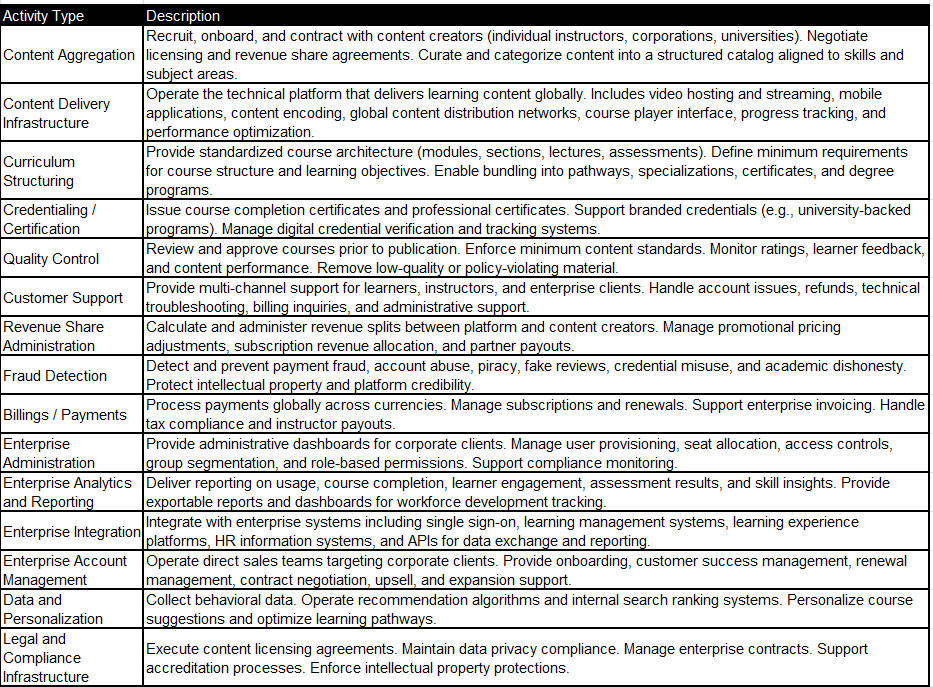
Some of these activities LLMs can do today. Others not just yet but could if given focus by the LLMs.
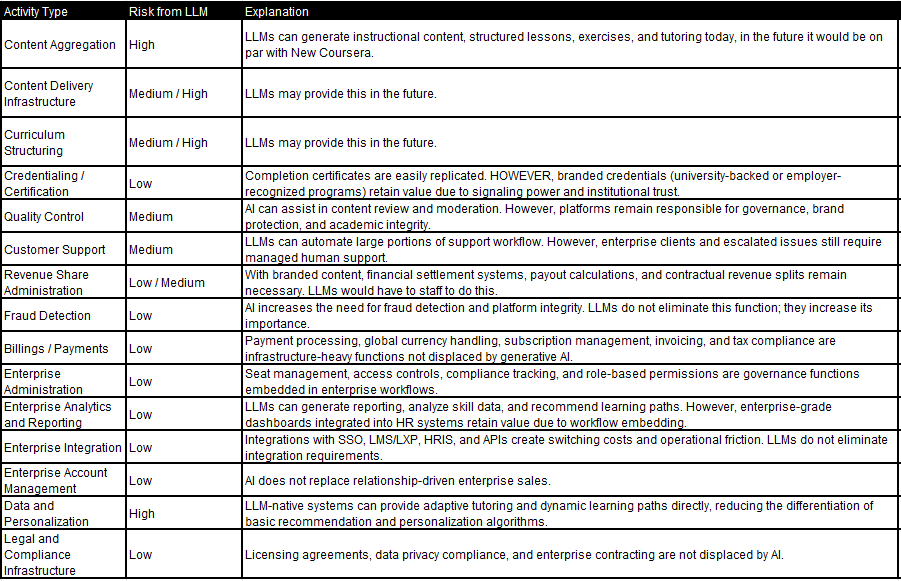
The biggest risk clearly exists on discovery and content generation.
Big picture, New Coursera provides credentialing infrastructure layered on top of content delivery. LLMs do not eliminate the market’s need for verified recognition of skills mastery.
A credential signals to employers that structured learning occurred, assessments were completed, identity was verified, and that a branded institution stands behind the outcome. It allows employers to distinguish between self-asserted knowledge and externally validated competence.
For enterprises, credentials enable skills mapping and workforce planning. Completed coursework updates employee skill inventories, supports internal mobility, and aligns training with strategic needs. That data becomes part of corporate infrastructure.
For consumers, credentials matter for job mobility. Many learners are mid-career professionals seeking demonstration of updated skills. In a competitive labor market reshaped by AI verified certifications provide differentiation that informal learning does not.
The central question is not whether AI can generate content. It obviously can.
The question is whether AI platforms will assume the economic, regulatory, reputational, and operational burden of becoming credentialing infrastructure.
If Credentials Matter, Why Can’t LLM Providers Issue Their Own?
From a technology perspective, it wouldn’t be that difficult for ChatGPT or another LLM to create a structured course, administer assessments and issue a digital badge demonstrating skill mastery.
The constraint is not technical capability. It’s reputational and regulatory.
LLMs today operate primarily as information tools. They sit behind broad user agreements that limit liability for inaccurate outputs. The burden of interpretation rests with the user. There are no consequences associated with false information and hallucinations. The user bears responsibility for using the materials from the LLM.
Issuing credentials is different.
Offering information, some of which can be false or biased, is quite different than serving as a guarantor of capability. A credentialing body implicitly guarantees that standards were met and that processes were controlled. That creates reputational exposure and potentially regulatory scrutiny. Institutional credentialing requires documented assessments, identity controls, audit trails, and governance frameworks that withstand employer review.
A credential matters only if employers treat it as a credible signal. Employers must decide whether they trust that standard, the integrity of the testing process, and the consistency of evaluation.
For LLM providers, moving from a horizontal information platform to a vertical credentialing authority would require assuming legal, operational, and reputational risk that does not obviously align with their scale driven model.
Are Intermediary Marketplaces Still Needed with LLMs?
If discovery shifts from search engines to LLM conversations, the traditional marketplace model weakens and/or ceases to exist. Marketplaces historically created value by aggregating demand, ranking supply, and converting traffic. If LLMs control the starting point of user intent, that aggregation function loses value.
Marketplace models inherently require customer acquisition costs to drive traffic. When a learner describes a goal conversationally and receives a direct recommendation from an LLM, the marketplace can only control discovery at a cost. The LLM can route traffic directly to IBM, Google, or a university partner unless it has an economic incentive to route to an aggregator.
So here are the questions we need to grapple with when thinking about New Coursera’s business model.
If an LLM can surface the most relevant IBM course directly, why must that course reside on Coursera?
Why should IBM share economics with a marketplace if it can host the course natively and let the LLM route traffic?
Why should enterprises contract with Coursera if an LLM provider could theoretically integrate credentials directly?
New Coursera’s value exists if it can provide an infrastructure layer embedded with the LLM ecosystem. This includes activities like managing payments, compliance, identity verification, enterprise integrations, revenue-share systems with course providers, and risk.
Today, Google has a 90% market share in search. Forecasts suggest that by 2030, traditional search may represent closer to half of total queries, with LLM search absorbing the rest. Coursera likely has several years before acquisition economics structurally deteriorate.

One of the more thoughtful pieces I came across examining how LLMs may reshape marketplace economics is LLMs vs. Marketplaces by Dan Hockenmaier. I would encourage any and every investor to read this piece, its incredibly insightful.
Hockenmaier’s core argument is not that marketplaces disappear. It is that LLMs commoditize discovery and ranking. Marketplaces whose value is primarily traffic aggregation and listing organization are vulnerable. Marketplaces that own transaction infrastructure, operational execution, compliance, and trust mechanisms are more defensible.
He illustrates this through a two-axis matrix.
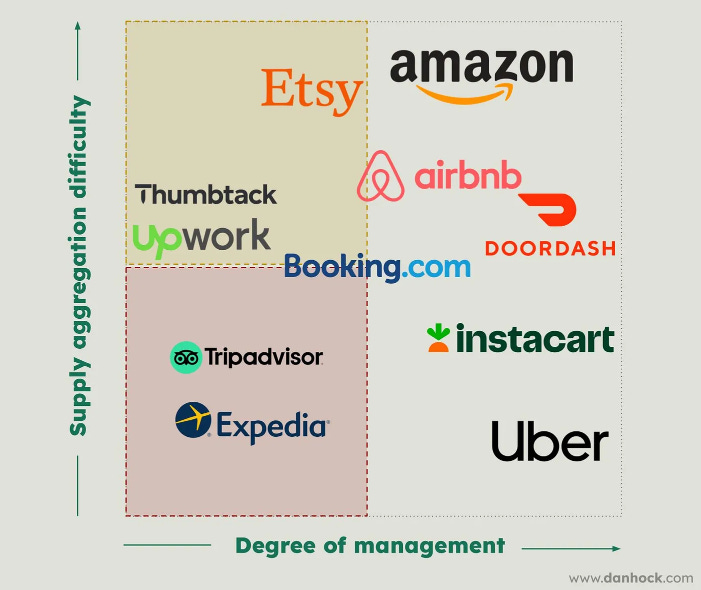
The vertical axis measures supply aggregation difficulty. Higher on the grid means supply is fragmented, heterogeneous, and operationally difficult to assemble. Lower means supply is standardized and easily indexed.
The horizontal axis measures degree of operational management. Moving right means the platform controls payments, fulfillment, dispute resolution, trust enforcement, and execution risk. Moving left means the platform primarily matches and ranks.
In the bottom-left quadrant sit lighter-weight marketplaces such as TripAdvisor and Expedia. Their value is concentrated in discovery, comparison, and routing. They help users find and evaluate options. They do not manage fulfillment. The flight operates regardless of Expedia’s existence. If a LLM becomes the primary interface for search and comparison, the discovery layer becomes commoditized. While Expedia maintains relationships with global distribution systems such as Sabre, Amadeus, and Travelport, as well as hotel chains, an LLM provider with sufficient focus and incentive could theoretically replicate those integrations.
In the top-right quadrant sit more defensible platforms such as Amazon, Airbnb, and DoorDash. These marketplaces aggregate complex supply and actively manage execution. Amazon operates payments, fulfillment, logistics, and returns. Airbnb enforces standards, processes payments, mediates disputes, and maintains reputation systems.
New Coursera likely sits somewhere in the middle of this grid.
On the one hand, supply in the form of courses is difficult to aggregate. Universities, corporations, and credential providers are operationally complex to onboard and standardize. Coursera’s 2025 Q3 10-Q notes that approximately 23% of revenue came from its top five content and credentialing partners. That implies some concentration but not extreme dependency. The platform is not a single-supplier business. That being said, the course relationship with Google for example will move the needle on financials and the stock price.
On the management axis, New Coursera provides materially more infrastructure than a thin listing marketplace. It operates the learning environment, payment processing, identity verification, assessment systems, credential issuance, enterprise reporting, compliance tracking, and revenue share administration. It integrates with enterprise HR and learning management systems. It manages renewals and customer success.
New Coursera does not manage fulfillment like Amazon. There is no logistics layer that would require a great deal of capital expenditures to replicate. Physical infrastructure creates defensibility that New Coursera lacks.
So why can’t LLMs simply replicate the credentialing infrastructure layer?
They could but I don’t think that its likely.
Competing directly would require contracting with universities and enterprises, building credential verification systems, developing enterprise integrations and compliance tooling, operating billing and revenue share systems, and running sales, renewals, and customer success. That is a services-heavy operationally complex business with regulatory and reputational exposure.
Secondly, I suspect that LLMs may prefer not to vertically integrate into every transaction domain. If they remain horizontal platforms, marketplaces retain value albeit at reduced economics as a coordinating layer sitting between institutions, enterprises, and learners.
The fact that I am describing the viability of New Coursera’s basic business model suggests that investor skepticism is warranted.
This is where a strong management team with the right strategy becomes very important.
Think Netflix and Blockbuster. Both companies understood that their existing business models were under threat from streaming. Both companies were positioned to pivot given the deficiencies in their business model. Only one company made the transition. Management is key.
Coursera management has taken two actions that suggest it understands the structural shift underway.
The first is the acquisition. Achieving scale and eliminating duplicative costs ahead of potential margin compression was the right call.
The second was Coursera actively working with ChatGPT. Coursera was one of the first companies that announced an app on the ChatGPT platform. To be clear, the app isn’t great. CEO Greg Hart in the Q4 2025 conference call said that the integration is “still very early days”. But engagement with AI distribution and embracing the opportunity as an early adopter suggests, at least to me, that management understands the opportunity and threats.
Risks to New Coursera’s P&L
Distribution Risk: Customer Acquisition Costs Rise
Historically, Coursera and Udemy acquired a meaningful portion of consumer traffic through search intent. A user searching for product management certification represents high-intent demand. The platforms invested in search engine marketing and search engine optimization to capture that intent.
SEO created near zero marginal cost traffic once ranking was achieved in search. Paid search through identifying the best keywords minimized cost to acquire traffic. Neither company currently discloses lead generation composition, but it is reasonable to assume that organic and paid search represent a significant portion of consumer acquisition.
If discovery migrates to LLM interfaces, organic search likely deteriorates.
The speed of the deterioration is unclear. Consumer behavior has already adjusted to AI. According to a survey by consulting firm Bain, 80% of search users rely on AI summaries at least 40% of the time. 60% of searches now end without the user progressing to another destination site.
If organic discovery declines, customer acquisition costs rise. Platforms must either pay the AI distribution layer for traffic or invest more in brand and partnerships. This pressures margins.
It would be reductive to say that it completely destroys the company as some have suggested to me.
Operating LLMs is capital intensive. OpenAI CEO Sam Altman went from saying that “I hate ads” to “maybe they don’t suck”. Operating these LLMs are quite expensive. There is speculation suggesting that OpenAI may go bankrupt by mid-2027. The LLM business model will likely require advertising content. This favors companies that can provide advertising dollars to the LLMs.
The key question is, if New Coursera has $115M in expense synergies, will those dollars represent less or more than the dollars that will now need to go to the LLMs for search?
One risk mitigant is the emerging field of LLM SEO. As discovery shifts from ranked links to generated answers, optimization moves from appearing first on a search results page to being embedded inside the LLM’s conversation response. LLM SEO is about becoming the cited and trusted source that the model retrieves when answering a query.
The mechanics of how this works are still evolving. It is reasonable to assume that AI systems prioritizing credibility in career-related queries will privilege branded credentials tied to recognized institutions. A Google Professional Certificate or IBM-backed credential carries signaling value.
New Coursera’s partnerships with leading universities and corporations create an advantage in this environment. Credentials backed by established brands are more likely to be surfaced in AI-generated career guidance responses because they align with relevance and authority signals.
If New Coursera’s credentialing infrastructure continues to provide value to institutional partners (verification, reporting, and enterprise integration), those institutions have an incentive to maintain the relationship with New Coursera
This is another reason why the merger is so important. New Coursera needs to have the strongest enterprise distribution platform, which Udemy has, to protect the consumer business, where Coursera dominates.
Content - Pricing for Enterprise Customers Diminish
If high-quality instructional content approaches near zero marginal cost, the content layer becomes easier to substitute. When content becomes cheaper, procurement departments renegotiate. Even if enterprises continue to value credentialing infrastructure, they may resist paying premium prices for bundled solutions that include commoditized instruction.
This creates a structural requirement for New Coursera to move further up the enterprise learning and talent management stack.
If the company serves solely as a distributor of third-party content, AI-driven content commoditization will pressure pricing over time. Enterprise customers ultimately pay for outcomes: skills mapping, compliance, workforce planning, and measurable capability development.
New Coursera must deepen its integration into enterprise systems and workflows. That requires investment and M&A. Again, the merger between Coursera and Udemy eliminates wasteful duplicative investment by both parties.
The AI Threat May Explain Why the Merger May Have Taken Place
Until Coursera/Udemy files its S-4 with the SEC, it’s purely speculative on my part as to why the merger really took place. Not just the talking points provided on the merger call. The S-4 will allow us insight as to when the discussions began, who initiated contact, the strategic rationale for the merger, the expected synergies, and alternatives considered. That will be quite an interesting read.
In the merger call Coursera CEO Greg Hart framed the acquisition as driven by five core pillars: “greater value, impact and choice; leading platform capabilities, accelerated AI native innovation; enhanced global reach and market opportunities; and a stronger long-term financial profile.” I think that the entire rationale was AI. Again, we’ll see what the S-4 says.
I’ve followed the education industry for twenty years. I was blindsided by the merger, I suspect others were too.
The merger always made theoretical sense given the complementary nature of the businesses, but there was no obvious catalyst forcing immediate action. Both companies had recently appointed new CEOs. Transformative transactions are not typically the first move of newly installed leadership teams when the businesses aren’t under obvious financial duress. Both management teams were publicly articulating credible standalone strategies. There was no visible activist pressure. No balance sheet issues.
In October I attended an education investor event where Udemy CEO Hugo Sarrazin spoke about the opportunities and risks associated with AI. He was not there to talk about Udemy’s operating plan. The discussion was framed around AI and the future landscape.
Mr. Sarrazin highlighted AI and its downstream implications. He did not rely on buzzwords. He broke complex dynamics into simple causal chains and explained second-order effects. He wasn’t a slick salesperson like one would find at an enterprise software company. Many in the audience, including myself, were struck by the magnitude of change implied by his analysis. Following his remarks, I increased my position in Udemy, believing he would be a disciplined steward of capital in an AI-disrupted landscape.
He joined Udemy in March 2025. His mandate did not include selling the company.
That is what makes the subsequent decision to pursue a merger notable. A CEO who demonstrates deep understanding of structural technological disruption typically seeks to reposition the business. Agreeing to a sale within the same year, without a clearly articulated long-term role in the combined entity, is atypical. It’s the first time I have witnessed that sequence in my investing career.
The merger conference call and accompanying presentation was sparse on details. Investors have limited visibility into brand strategy, product consolidation, and enterprise go-to-market alignment.
In a world where customer acquisition costs may rise and pricing power may weaken, eliminating duplicative cost structures and combining distribution is economically rational. Scale improves negotiating leverage. It spreads AI investment across a larger revenue base. It increases enterprise cross-sell opportunity. It reduces the risk of parallel investment under margin pressure.
If AI compresses standalone marketplace economics, industry consolidation of two complementary businesses clearly is the best decision.
New Coursera in the Context of the Broader AI Driven Sell-Off
Since the merger announcement, Coursera and Udemy shares have declined approximately 20%. Over the same period, the S&P North American Technology Software Index (SPGSTISO) declined by a similar magnitude.
The market is broadly reassessing businesses perceived to be exposed to AI substitution risk. Enterprise software, data analytics platforms, and education technology have traded in sympathy as investors reassess durability and pricing power.
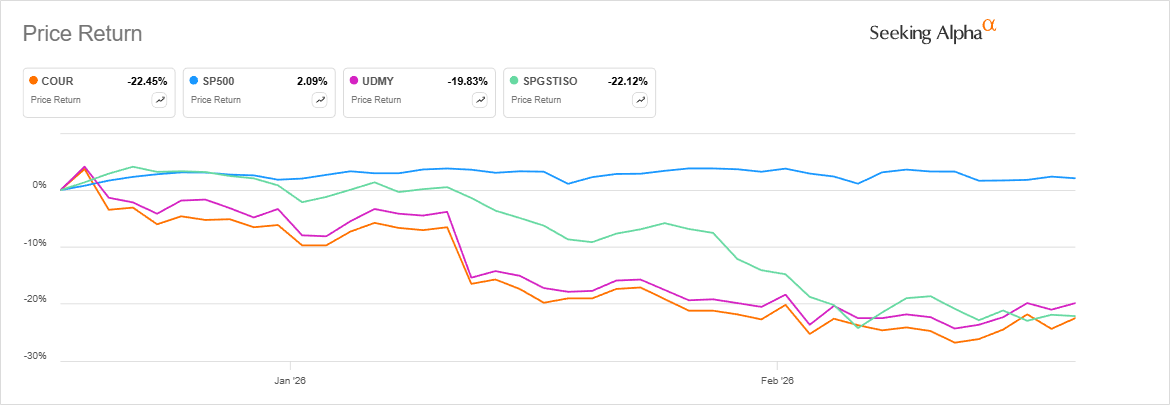
For the past several months there has been a daily barrage of news highlighting AI advancements. Most notable was the news and speculation on Claude’s Cowork tool. The decline may reflect fears of substitution in the not too distant future from LLMs.
The market has already seen a clear precedent in edtech provider Chegg. After the launch of ChatGPT in 2022, Chegg’s revenue declined sequentially over multiple years. Chegg revenue declined by 7% in 2023, 14% in 2024, and then by 39% in 2025. The business model, selling answers, was directly substitutable. Enterprise value collapsed accordingly.
That experience is now the template investors use when evaluating digital learning platform.
The broader AI sell-off in enterprise software reflects a separate but related concern. Autonomous AI agents may alter seat-based pricing models, compress software spend, and shift pricing toward usage-based consumption. Investors are questioning long-term SaaS revenue visibility. Industry observers are throwing around words like apocalypse and extinction level event.
There are two interesting takeaways I have from this software sell-off.
1) As investors are grappling with existential issues in enterprise software, its important to note that New Coursera has a model anchored to the learner. Its seat based model isn’t under assault in the way that it is for enterprise software companies.
2) Investors arguing that software faces structural contraction should consider the labor implications of that thesis. If AI reduces demand for certain roles or increases perceived job insecurity among knowledge workers, affected employees will likely seek reskilling and externally validated credentials in response to remain competitive. Even absent layoffs, heightened uncertainty drives proactive skill upgrading.
So Why Do I Still Own Coursera and Udemy Stocks?
Up to this point, the analysis has focused on structural risk. My assessment up until this point may sound bleak.
As I said, I’m still a shareholder.
At approximately 1.9x pro forma EV/EBITDA, the stock trades at a multiple consistent with structural decline. If credential relevance erodes, if customer acquisition costs rise materially, and if enterprise pricing compresses faster than anticipated, the multiple is justified.
Bears may characterize this as a value trap. They might be right. We’ll find out in a year.
There are two data points in particular I come back to when I have doubts about stock ownership.
1) Document evidence exists that AI has disproportionately impacted entry-level workers in the US. Which makes sense from what I’ve heard anecdotally.
2) the number of applicants at law schools have surged 40% over the past two years. There are publicly stated reasons for it, most referring to a difficult job market. Elevated labor market uncertainty appears to be a contributing driver.
These are signals of a major labor market transition. It’s a situation that reminds me of the character Carmine Lupertazzi Jr. who told Tony Soprano “You are on the precipice, Tony, of an enormous crossroad”.
If AI reduces demand for certain labor categories, particularly white-collar roles, the adjustment will be rough. Career paths will become less predictable.
Periods of labor dislocation historically produce a predictable behavioral response. Workers seek formal signaling mechanisms to either maintain or re-establish employability. When job security declines, the value of externally validated credentials rises. Individuals invest in lifelong education to differentiate themselves in a more competitive market.
If the coming decade resembles prior technological shifts, demand for proof of competence may rise, not fall.
So here is the elevator pitch for owning the stock.
Credentials will remain relevant in the future, and if anything will become more important in an age of AI where white-collar workers will see meaningful job displacement.
The demand for credentials may accelerate New Coursera revenue growth.
The merger is complementary in nature, fixing challenges in each party’s respective businesses.
Management is likely conservative on EBITDA synergy guidance. Management has guided $115M of annualized run rate cost synergies over two years. Both Coursera and Udemy historically have provided conservative guidance to the Street for forward revenue and EBITDA/EPS. I presume that the cost synergy guidance is consistent with their historic conservatism.
Management has made a commitment to share repurchases following the acquisition. Both companies have an aggregate value of over $1B of cash on their balance sheets.
Merger Strategic Rationale
In this document thus far I’ve alluded to the need and benefit of the merger, the point being that scale is key. In this section I will go a bit more depth on the complementary nature of the merger.
Some analysts have suggested concern about execution risk following the merger. Platform integration, brand architecture decisions, cost rationalization, and cultural alignment are non-trivial challenges.
Those risks are worth it. The merger addresses structural weaknesses in each of the standalone business models.
Consumer Segment Benefits
Coursera brings institutional brand equity. Its partnerships with universities and large corporations provide externally validated credentials that carry labor market signaling value. Udemy has credentials, but for the most part it’s for courses from individual instructors.
Consumers with favorable LTV/CAC characteristics are not purchasing raw instructional content. Content is abundant and increasingly free. The durable consumer segment is composed of individuals seeking credentials that can be credibly presented to employers.
Coursera’s model aligns with that demand.
Udemy historically operated a broader more open marketplace. While that drove scale, it lacked brand endorsement. As AI compresses the value of undifferentiated content, institutional backing becomes more important. It’s fascinating that pre-merger Udemy announced a deal with Google for a newly launched AI Professional Certificate. Presumably it was a work in progress prior to the merger, and it’s interesting to see what the CEO was preparing to do if the company remained standalone.
Udemy had already been shifting away from consumer-driven growth toward enterprise. In 2025 it spent $80.6M in advertising dollars, presumably for its consumer business. Most of the consumer business was one-time transactional rather than a subscription and likely unprofitable (more on that later in the article). Those dollars would be better spent on customers seeking brand backed credentials.
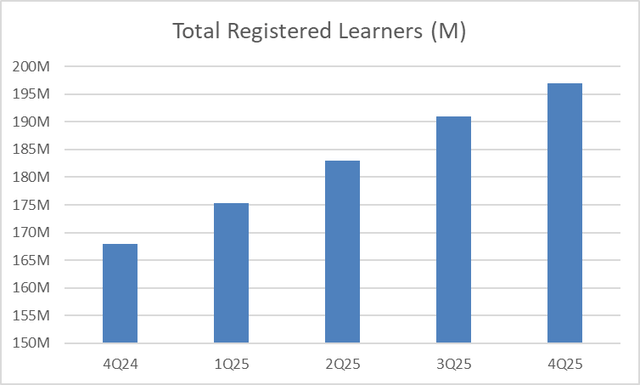
Coursera can serve as the flagship storefront for credential-seeking consumers, leveraging nearly 200M registered learners globally. That represents close to 3% of the global population. In an environment where customer acquisition costs may rise, that installed base who perhaps already has the app on their phone is valuable.
Enterprise Segment Benefits
US training expenditures reached over $100B in 2025. It’s a large market that New Coursera has a fraction of today. The addressable market is considerable. Perhaps generative AI creates a cost cutting opportunity and spend goes down. Perhaps not.
If job roles change rapidly, enterprises must retrain employees faster. Skills will obsolete more quickly. Content must update continuously. I posit that enterprises will favor platforms that can rapidly produce, distribute, and credential new competencies. That’s New Coursera.
Coursera historically struggled to penetrate the enterprise segment. Udemy has distribution to over 17K customers, while Coursera only has 1700 enterprise customers. I’m not sure why that is the case. It could be a lack of focus. It could be the inherent value proposition of a branded credential vs. a demonstration of skill.
For consumers, branded credentials carry signaling value. For enterprises, the priority is workforce impact at scale. Enterprises optimize for breadth of catalog, ease of deployment, administrative tools, and price per-seat. The brand issuing the course may be secondary to measurable skill acquisition and utilization rates.
That dynamic likely explains pricing differences in the market. Udemy historically competed on accessibility and catalog depth, pricing around $360/seat/year versus Coursera’s roughly $399/seat/year. Coursera’s premium presumably reflects institutional brand partnerships.
New Coursera can now segment enterprise accounts with a layered offering:
A broad base catalog for large-scale workforce coverage
Premium, branded credential programs, perhaps for executive education.
There are potential cross-sell revenue opportunities here. Interestingly, management did not quantify the opportunity in the merger call. Portfolio breadth plus credential depth is economically stronger than standalone.
Acquisition Finally Solves the Udemy Mix Shift Issue from Consumer to Enterprise
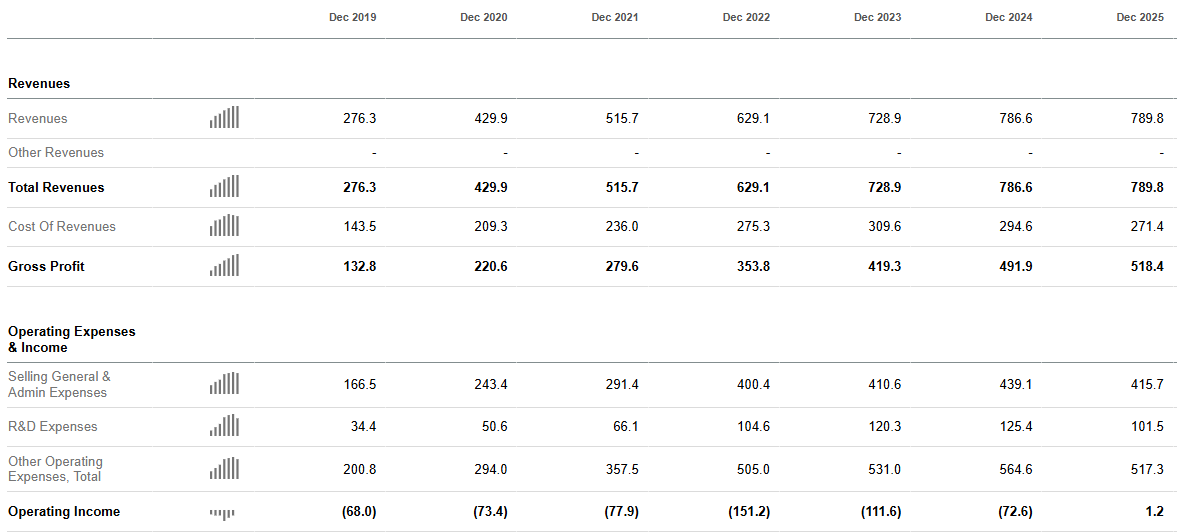
Over the past three years, Udemy management attempted to pivot the company away from an economically challenged consumer transactional marketplace toward a higher margin enterprise subscription business. The company was largely successful in its effort but unfortunately revenue stagnated, even as the quality of revenue and profitability improved.
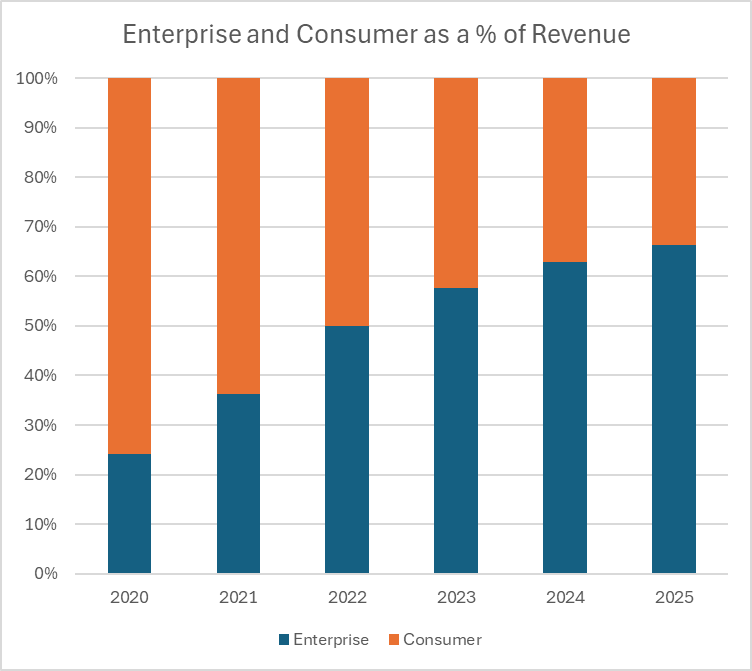
As enterprise revenue scaled, gross margins expanded and operating losses narrowed, reflecting a fundamentally healthier business mix.
In Q3 2025, Udemy’s CEO provided rare clarity on the consumer segment’s fundamental weakness, acknowledging a Lifetime Value (LTV) to Customer Acquisition Cost (CAC) ratio of 1x.
For those unfamiliar with this metric, LTV/CAC measures the total economic value a customer contributes over their lifetime relative to the cost required to acquire that customer. A ratio of 3x is typically considered the benchmark for a healthy business. At 1x, the company recoups acquisition costs after accounting for content creator revenue share. I don’t know their internal definition of LTV/CAC, so it’s unclear if this calculation includes allocated corporate overhead. It’s conceivable that the company loses money on this part of the business.
This revelation explains why management redirected resources toward enterprise offerings, which now account for nearly 70% of total revenue.
If Udemy had been privately held, management would have had the flexibility to restructure the business and consider extreme measures regarding this potentially unprofitable consumer business. Management had two options. First, to exit the business of transactional consumer purchases and focus solely on selling subscriptions that have a much higher LTV/CAC. Subscription consumer revenue represented 17% of total consumer revenue in 2025. Or second, to exit the consumer business altogether. In the second option, the company would have seen a temporary revenue reset, but would have had a structurally higher-margin enterprise business. Public market optics in my opinion prevented that outcome.
As a result, Udemy continued to subsidize a legacy model with poor unit economics.
New Coursera creates the opportunity Udemy lacked as a standalone public company. Under the umbrella of a strategic transaction, management now can rationalize or eliminate consumer advertising spend for Udemy consumer offerings. This decline in revenue can be reframed by New Coursera management as a synergy to unlock margin expansion that was always economically justified but difficult to execute.
Overall Benefits
Big picture the merger accomplishes the following:
Optimizes the consumer and enterprise channels as described above
Eliminates duplicative costs
Fixes the challenge of shifting Udemy’s business from consumer to enterprise
Eliminates future investments associated with AI content creation and user tools
Eliminates future investments associated with integrating the enterprise product into the HR tech stack
Valuation
Based on 2026 consensus estimates and pro forma adjustments, the combined entity is trading at liquidation-level multiples in my opinion.
At pro forma ~1.9x EV/2026 EBITDA, the market is effectively assuming business cessation at some point over the next several years. If New Coursera merely survives, without material revenue growth, it could trade closer to the 6–7x EV/EBITDA range implied by publicly traded education and training peers.
The publicly traded for-profit education companies are also in the business of providing credentials. One key difference is that they own their brands (e.g., Phoenix Education Partners owns University of Phoenix) while New Coursera rents its university and corporate brands non-exclusively. That being said, the brands that Coursera rents may have greater brand appeal than the publicly traded for-profits.
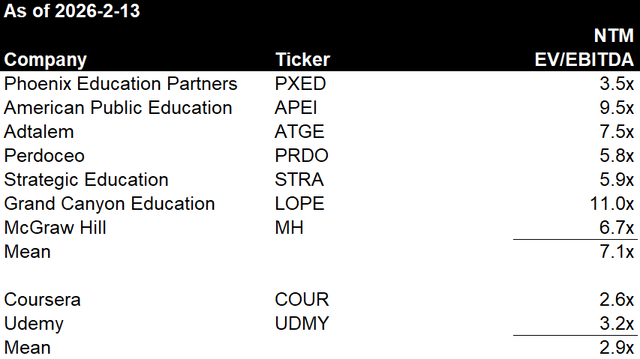
Below I provide my calculations for the implied 1.9x EV/EBITDA multiple for New Coursera on a pro forma basis. I calculate that New Coursera would trade at 1.5x EV/EBITDA with my hypothesis of $200M in expense synergies.
Risks
Here are risks related to the thesis I outlined:
Merger execution risk. The integration will clearly be complex, involving platform consolidation, go-to-market alignment, cost rationalization, and cultural integration. A lot can go wrong. Managing employee churn is key.
Management of Udemy content creators. Udemy is a marketplace for content creators to create courses sold to the enterprise and consumers. I imagine that the content creators are nervous about this merger. They should be more nervous about AI affecting the value of their content. The merger is a net positive for them, as a stronger New Coursera protects them from AI substitution.
AI substitution narrative persists despite beat and raise quarters. Even if fundamentals remain intact, investor sentiment may continue to penalize edtech businesses perceived as vulnerable to AI, suppressing valuation multiple expansion.
Credential relevance erosion. If employers increasingly on internal skill assessments, internal training, or AI evaluation of skills rather than third-party credentials, the long-term value of external credential could decline.
Deal may not go through. Deal expected to close in the 2H of 2026. Given the stock price performance, it’s conceivable that a select group of shareholders may seek to terminate the merger agreement.
New Coursera does not own the credentials that it sells. Rather, it licenses these credentials from third parties like corporations and universities. Management needs to sign long-term contracts with its content partners to provide protection.
Then there are the typical risks associated with any edtech company, like macroeconomic risk, loss of key employees, etc…
Conclusion
New Coursera trades at a distressed valuation multiple. The market clearly is assuming that much will go wrong presumably driven by AI displacement. We haven’t seen any of this yet. Perhaps that’s what Newspaper Industry analysts wrote with the advent of the Internet.
The core question is not whether AI changes the model. It will.
The question is whether credential signaling retains value in a labor market reshaped by automation. If the answer is yes, then I think that optimism is warranted at current price levels.
I’ll end this rather extended article with a quote by Charles Darwin:
“It is not the strongest of the species that survives, nor the most intelligent, but the one most responsive to change.”
The Coursera / Udemy merger is a good step in the right direction.
Appendix - Case Study of Chegg
Chegg once commanded a multibillion dollar market capitalization. Its value plummeted by more than 99% to less than $70M. This collapse was driven entirely by AI substitution of the company’s core product. This outcome is what I suspect many former owners of New Coursera stock feared.
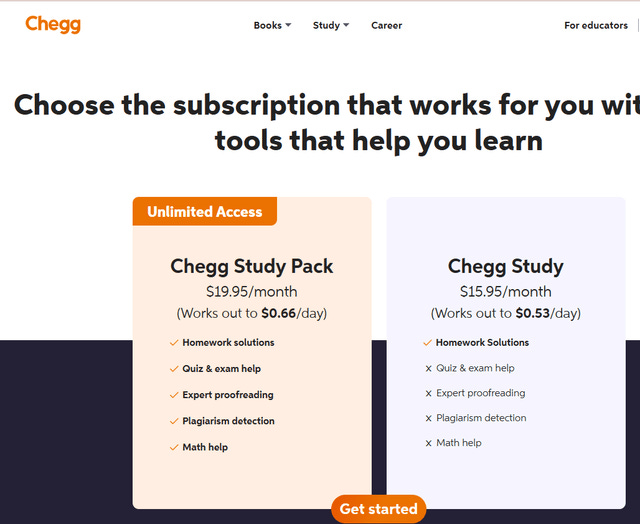
Chegg Study was a subscription based “homework helper”. It offered textbook solutions and expert Q&A to college students. The product was controversial. Critics argued that it helped students cheat rather than fostered genuine learning. Chegg’s product, sold to consumers, lacked institutional validity.
Chegg ultimately sold just content. Not outcomes. The product had no moat. Because Chegg’s value proposition was providing answers, it was immediately replaced by LLMs that could replicate the same output at a lower cost.
Chegg did not provide its learners with a credential. It helped learners progress (some would say cheat) through a course with a path toward receiving a credential at their respective universities.
I’ll submit that any prospective investor should sign up for both Chegg Study and Coursera. You see very different marketing messages to the consumer. Chegg offers “homework solutions”, “quiz & exam help”, “plagiarism detection”, etc…
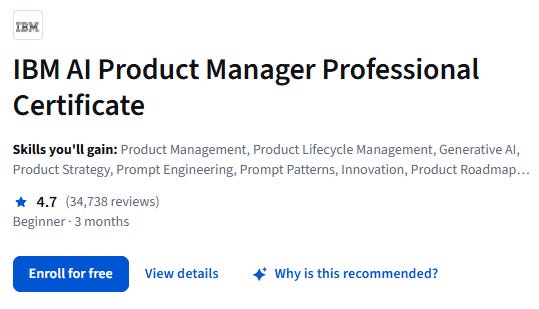
Meanwhile Coursera offers an actual certificate with a branded entity. In the screenshot below, you can see that Coursera offers an IBM branded product manager professional certificate.
But just visiting the landing page of each company does not do justice to the value of the Coursera course. The output is the digital certification from the branded entity. See below the digital certificate I received from Coursera after taking a course from Google, placed on my LinkedIn account. In a recent Novoresume survey of over 200 HR professionals in the United States, it was reported that LinkedIn has become a meaningful input in hiring, with the vast majority of HR professionals using candidate profiles in their evaluations and a sizable minority viewing them as decisive when identifying top talent.

Disclaimer / Disclosure
The author beneficially owns shares of Coursera, Inc. (NYSE: COUR) and Udemy, Inc. (NASDAQ: UDMY). As a result, the author has a financial interest in the performance of these securities, and readers should consider this potential conflict of interest when evaluating the analysis and conclusions presented herein.
This document reflects the author’s personal views and opinions as of the date of publication and is subject to change without notice. The information contained herein has been obtained from publicly available sources believed to be reliable; however, the author makes no representation or warranty, express or implied, as to the accuracy, completeness, or timeliness of the information.
This material is provided solely for informational and educational purposes and does not constitute investment advice, legal advice, accounting advice, or tax advice. Nothing herein constitutes an offer to sell, a solicitation of an offer to buy, or a recommendation regarding any securities transaction. Any forward-looking statements are inherently subject to risks, uncertainties, and assumptions, and actual results may differ materially.
Investors should conduct their own independent due diligence and consult their financial, legal, and tax advisors before making any investment decisions.