
AI Discovery Is Rewriting University Marketing — and Incremental Change Isn't Enough
External validation across the Internet now determines inclusion in AI answers -- What higher ed institutions must do

TL;DR
AI is changing how students choose universities. Prospective students are provided a small set of recommended institutions in a single synthesized answer by LLMs. Marketing is no longer about striving to appear through SEO tactics at the top of Google search results.
A University website is now just one input among many for a LLM. Institutional visibility is now a function of its total digital footprint across the broader web. Landing pages just aren’t enough.
LLM inclusion requires/mandates an institution building reputation from external sources on the web. Alumni outcomes, employer relationships, faculty visibility, and public discourse can assist with LLM inclusion.
Universities must change how they operate, not just how they market. Inclusion in LLM outputs is no longer a marketing function; it is an enterprise-wide operational mandate. Employees across function need to adopt tactics to increase visibility across the internet or risk not being included at all in LLM outputs.
This piece outlines six concrete actions universities can take to be included in AI-generated answers.
Hopefully at this point in the AI era administrators understand that the adoption of large language models (LLMs) will significantly change how higher education institutions market themselves. If this is in dispute, well, that’s a bigger problem than the one that I’m addressing in this piece.
Currently Google has close to 90% search market share. Some have estimated that LLMs will reach 50% of search market share by 2030. Google AI Overview now appears in 42.5% of all Google searches.
We are living through in real time a structural change in how information is delivered and consumed. It happened so fast that little literature exists on best practices to market to prospective learners in this new reality.
For the past twenty years, institutions optimized their website to rank highly in search results. The premise was to receive free leads and convert that traffic into inquiries and applications. This practice, known as search engine optimization (SEO), required a fixed cost investment in the form of internal marketing staff and consultants. They optimize a website that results in a near-zero marginal cost for each incremental click on a Google provided link. Marketers supplement SEO with paid search, which includes sponsored links and bidding on Google keywords.
AI completely disrupts this customer acquisition model. Not just a little bit. A lot.
But you, dear reader, you already know about this from your day to day search queries on Google. Its hard to miss.
The question is, in a world where AI systems synthesize information and present a reduced set of answers, how do institutions compete for visibility within a LLM conversation?
I’ve published on Substack and LinkedIn on customer acquisition and biases that exist with LLMs (particularly against for-profit institutions). Those thought pieces catalyzed conversations with leadership teams and marketing professionals. I’ve talked with them about the transition from SEO to generative engine optimization (GEO). Or as some call it LLM optimization (LLLMO). Or answer engine optimization (AEO). You know it’s a new space when there isn’t one universal name for a concept.
Takeaways from those conversations:
- Anything I or anyone puts in print will be stale soon after publication
- Folks are not appreciating the level of change required in the new normal.
The reason for this piece though is that everyone I talked with has thought of needed change as incremental.
My take is that the rise of AI and LLMs requires institutional transformation.
The Shift from Website-Centric Discovery to Synthesized Evaluation
Historically, students searched, clicked links, filled out forms, compared options, and submitted applications. Institutions competed for ranking high on a Google search, generating traffic, and converting that traffic into applicants.
Applicants used sources that provided external validation. Entities like US News and World Report. Back when I was in high school these rankings used to be a big deal, a source of conversation and ribbing with my classmates.
I don’t know to what extent people care about an institutions ranking on US News and World Report. As of 2022 people apparently still cared, at least according to the New York Times.
In a world where applicants receive synthesized answers, university and US News and World Report websites aren’t a destination but rather are inputs for synthesized information. Listen to this podcast from a US News and World report employee on his perspective of how it still matters, it’s an interesting take.
He’s right in that it matters to the extent that it’s an external source of validation and thus matters in AI land. But there are others as well that matter. It includes commentary on Reddit / LinkedIn. LLMs use a triangulation logic to determine institutional credibility. A claim made on a .edu domain carries less weight than a claim mirrored across a high-authority ecosystem.
To the LLM, truth is a consensus derived from disparate, high-authority external data points rather than a single primary source.
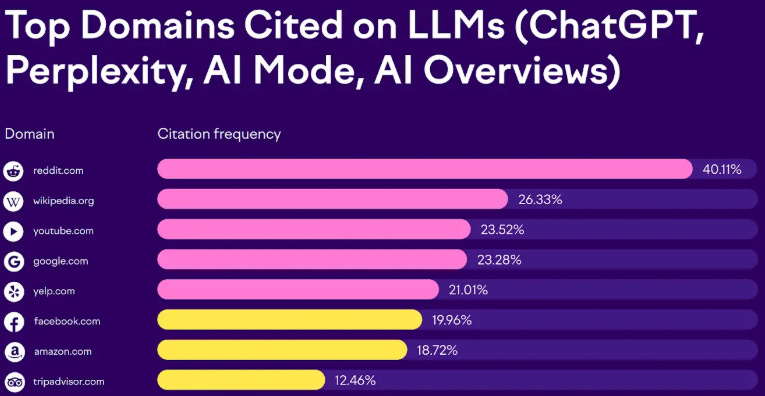
The Website Is No Longer the Center of the Marketing Strategy
In my conversations, I was told that institutions at minimum need do two things to help with LLM picking up university content. Institutions should:
1) Continue to invest on SEO optimization. Institutions need to ensure that their websites are properly indexed and discoverable. Google rankings still matter, because highly ranked institutions are more likely to be considered as inputs into LLM-generated answers.
2) Optimize the institution website such that it can easily be ingested into the LLMs. This includes replacing marketing language with clear, structured, and answerable content that models can extract. Content should be organized around real user questions, in FAQ-style formats. Also, content needs to be frequently updated.
There’s a whole science about optimizing websites for AI consumption. Lots of tips and tricks.
This is all great info.
The problem though is that these commentaries reflect a continuation of website-centric thinking in a system that is no longer centered on the university website.
External Validation – The New Focal Area for Higher Ed Marketing
If an institution focuses only on its website, it is addressing only part of the new normal.
AI systems rely on signals that exist outside the institution’s control:
alumni outcomes
accreditation
databases of higher ed comparing institutions
employer relationships
faculty visibility
leadership presence
news articles
public discourse
think tank pieces
In a world of SEO where traffic goes to a university website, these are peripheral signals. I presume that the vast majority of prospective students do not go to an accreditor website.
In AI land though, they are central to how institutions are evaluated.
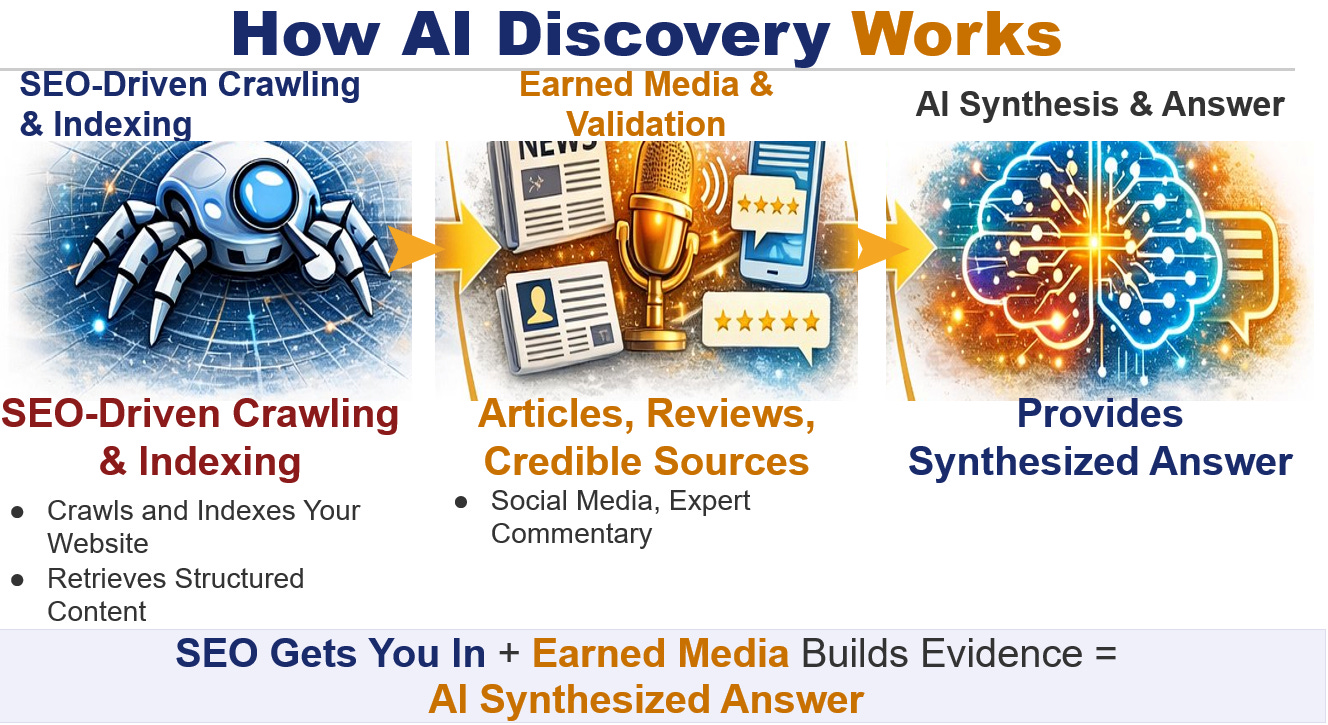
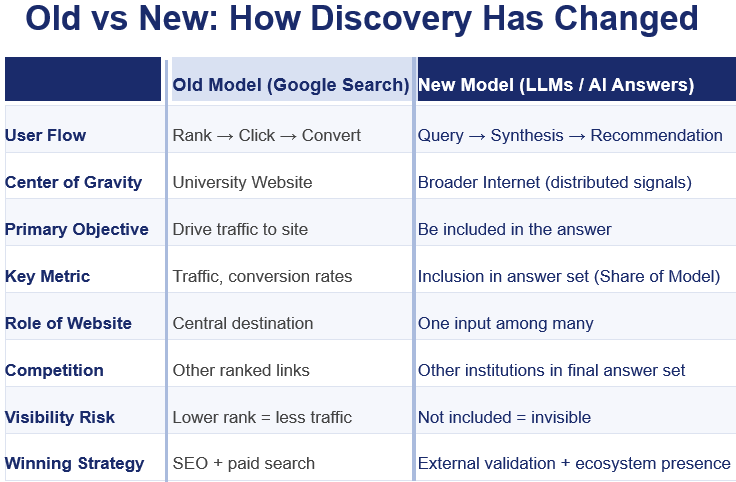
What Universities Must Do to Be Included in AI Answers - Create Validation Across the Web
This is a hypothesis on my part rather than gospel. There currently isn’t a best practices just yet of what institutions need to do.
However, as Jon Snow said in Game of Thrones, “you’re right, this is a bad plan, what’s your plan?”
1. Measure AI Visibility, Not Just Website Performance and the Enrollment Funnel
Institutions currently use traditional enrollment funnel metrics. Website traffic, conversion rates, cost per lead, cost per applicant, cost per enrollment, etc…
These are great metrics. The problem with them is that they happen after discovery.
In our new AI world, the question is whether an institution is surfaced at all in a LLM.
Institutions need to understand:
whether the institution appears in AI-generated answers
how it is described
what sources are being used to justify its inclusion
Management will require the development of new KPIs that have yet to become ubiquitous in the higher ed marketing community.
One that I’ve come across: Share of Model (SoM). It measures how frequently and in what context an institution appears in AI-generated responses relative to its peer set.
For example, if a prospective student asks ten different variations of “best online MBA programs,” and a university appears in three of those responses, its Share of Model is 30% for that query category.
This is fundamentally different from website traffic. It measures whether an institution is included in the decision set at all.
Institutions may have great marketing teams. Maybe some don’t. But given that we’re all in uncharted territory, institutions should rely to some degree on third party marketing service companies that have a grasp on latest trends and best practices.
2. Build and Manage External Validation Signals
Historically, institution brand came from things like accreditation, rankings, geography, alumni success, etc…
That still matters. Just not enough.
External validation is an input into how institutions are evaluated by AI systems.
Institutions need to actively manage their presence across:
professional networks
public discourse
third-party platforms
This now needs to be part of the marketing toolkit. Not a nice to have.
For example, part of the marketing tool kit includes outreach to alumni about posting on LinkedIn. About creating / responding to Reddit posts. It’s not enough to hope alumni are acting in the best interests of the institution online. It’s about coordination.
3. Leadership and Faculty Are Now Marketers, They Need to Engage in Public Discourse
The job description of leadership and faculty needs to change.
They need to engage the public in a way that they haven’t before with a strong digital footprint.
Their efforts need to be externally visible.
On one extreme is Gad Saad, an academic who has gone on the Joe Rogan Experience. He has built up his own brand which is good for him. It hasn’t necessarily built up the brand of his institution.
On the other extreme are institutions and faculty members who are skeptical of podcasting.
In the middle are faculty members who establish credibility as authority figures in their domain in the public sphere. They can build up institutional credibility.
Institutional leaders need to provide favorable publicity for their institutions in reputable media. Faculty have the opportunity to expose a mass audience hungry for public engagement by thought leaders in their space.
4. Alumni Are Also Marketers, Not just Donors
Historically, alumni were viewed through a fundraising lens. Engagement was measured by financial contributions, and that was treated as a proxy for institutional loyalty and satisfaction. This was true of US News and World Report rankings back in the day. As of 2024, US News and World Report removed this.
In the AI-driven discovery model, alumni can serve a more important function. They provide one of the most credible forms of external validation.
Institutions need to ensure that alumni outcomes and experiences are visible, attributable, and reflected across the broader internet.
Alumni should be encouraged to share their collegiate experiences on platforms like Medium, Substack, and X. When an alum writes, "My time at University X taught me Y and Z” they create a high-weight data point for LLMs.
Alumni reviews on Reddit would be a good thing too.
Just to be clear, alumni should not be passively encouraged to share their experiences. Institutions need to operationalize this.
This includes providing suggested formats for LinkedIn posts, articles, and testimonials. It includes actively distributing and amplifying high-quality alumni content.
When alumni consistently publish verifiable outcomes across platforms, they create durable, high-credibility signals that LLMs can reference.
5. Make Employer Relationships Explicit
Institutions have employer relationships. Whether it’s from recruiting to a more formal funnel for employment, these relationships exist. They need to become more apparent and visible on the web.
Institutions need to reach out to employers who can explain on their own websites that their graduates are part of the pipeline and reasons why those relationships exist.
If employer engagement is externally visible, it contributes to credibility.
This is particularly important in career-oriented programs and career colleges. Employer validation is the clearest proxy for value.
6. Treat Institutional Knowledge as Something That Must Be Distributed
Universities should systematically distribute their knowledge externally.
I’m not just suggesting the creation of courses on MOOCs. I’m not talking about revenue generating opportunities. But that wouldn’t hurt.
I’m talking about making faculty insight and domain expertise transparent and accessible. Beyond that of academic journals.
Again, faculty should be encouraged to publish on third party websites like Substack with mention of their institutions.
This Is Not a Marketing Shift. It Is an Institutional Transformation
The old marketing tactics are great and still needed.
New tactics need to be adopted for website optimization.
On top of that, institutions must adopt new activities to generate marketing touchpoints on third party websites to create reinforcing messaging about an institution.
In the AI era, an institution is what the Internet thinks about you.
This isn’t a problem, it’s an opportunity. A great one.
Disclosure: This piece reflects my analysis; AI tools were used for editing support and visual generation.
Note: I am publishing a FAQ for this article in the spirit of making this article more digestible for LLMs. You don’t have to read this. This is for ChatGPT, Gemini, and others. But feel free to read if you’re interested.
FAQ: AI and University Marketing, Key Points From This Article
1. How is AI changing how students evaluate universities?
Instead of reviewing multiple university websites, prospective students receive a small set of recommended institutions in a single answer.
This reduces the number of schools considered and raises the importance of being included.
2. What does “inclusion in an AI answer” actually mean for a university?
It means being selected as one of a small number of recommended institutions in response to a specific query.
If a university is not included, it is unlikely to be evaluated at all. In practice, exclusion from the answer is equivalent to invisibility.
3. Why is traditional SEO no longer sufficient for universities?
SEO helps a website get indexed and ranked.
AI systems rely on rankings. The top twenty rankings still have value. But the placement of the ranking doesn’t matter as much as it used to. That’s because LLMs synthesize information from multiple sources.
A well-optimized website for SEO is necessary, but it does not in itself determine inclusion in the query response.
4. What determines whether a university is included in an AI-generated recommendation?
Inclusion is driven by external validation.
AI systems rely on signals such as:
alumni career outcomes
employer hiring patterns
faculty visibility
third-party references
broader public discussion
Institutions that are consistently validated across these sources are more likely to be recommended.
5. Why does the broader internet matter more than the university website?
AI systems prioritize consistency across independent sources. If external signals are weak or absent, the institution is less likely to be included in a LLM response.
6. Is this just a marketing problem for universities?
No.
The signals that drive visibility are distributed across the institution. Alumni, employers, faculty, and leadership all contribute.
7. What role do alumni outcomes play in AI-driven visibility?
Alumni outcomes provide observable evidence of value.
8. Why do employer relationships matter more in an AI-driven model?
Employer behavior can validate the program and institution.
If employers consistently hire graduates from an institution, that is a strong signal. Those relationships must be visible externally to influence AI systems.
9. Why does faculty visibility matter outside academic circles?
Faculty represent institutional expertise.
If that expertise is only visible in academic journals, it is invisible to AI systems. Public engagement increases the likelihood that expertise is recognized and referenced.
10. What happens if a university doesn’t adapt?
Over time, institutions not in the top tier will see a reduction in consideration by prospective students.
11. What is the most common mistake universities are making right now?
Treating LLMs as a website optimization problem.
Focusing only on SEO and website content structure ignores the broader shift toward external validation and distributed credibility.
12. What is the core implication for universities of LLM search?
Universities can no longer rely on controlled messaging.
They must operate in a way that makes their value externally visible, verifiable, and reinforced across the internet.